


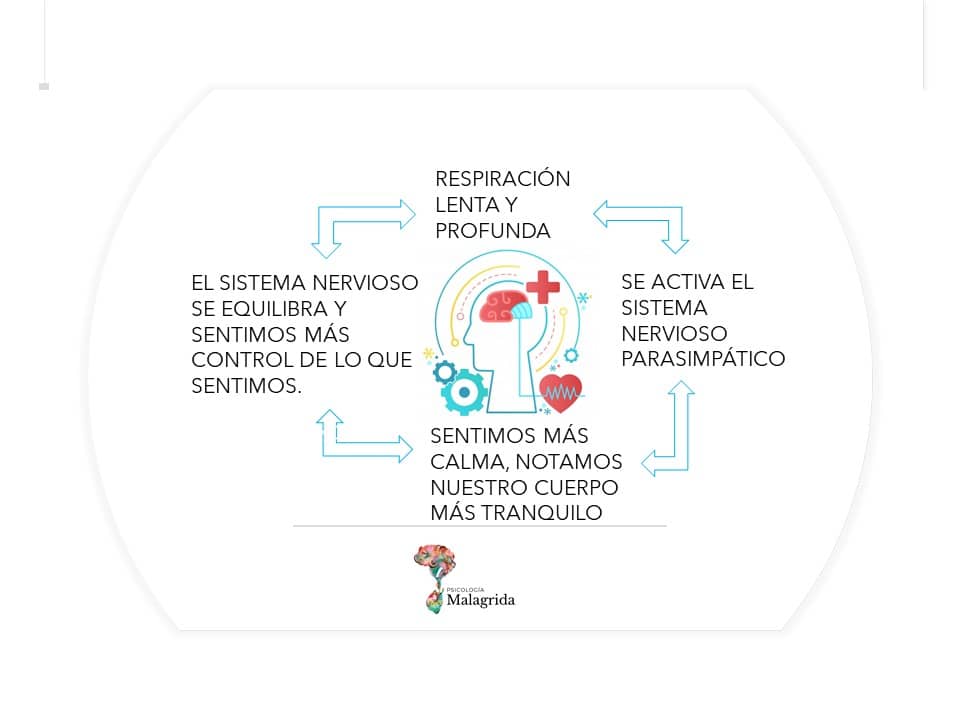
When we feel emotional discomfort such as anxiety, stress, nervousness, etc., our sympathetic nervous system (SNS) becomes hyperactive, breathing becomes faster and shallower, and the amount of oxygen reaching our body and brain decreases, and therefore there is a deterioration of the functioning of the nervous system and one increase in somatic and emotional discomfort. It’s the fish that bites its own tail; EVERY TIME WE FEEL WORSE…
But if we stop and pay attention to our breathing, maintaining a slower and deeper breathing cycle, it increases oxygenation of the brain, the SNS decreases, and the Parasympathetic Nervous System is activated, generating a greater sense of emotional and bodily calm. Breathing allows us to have greater control when regulating emotion..

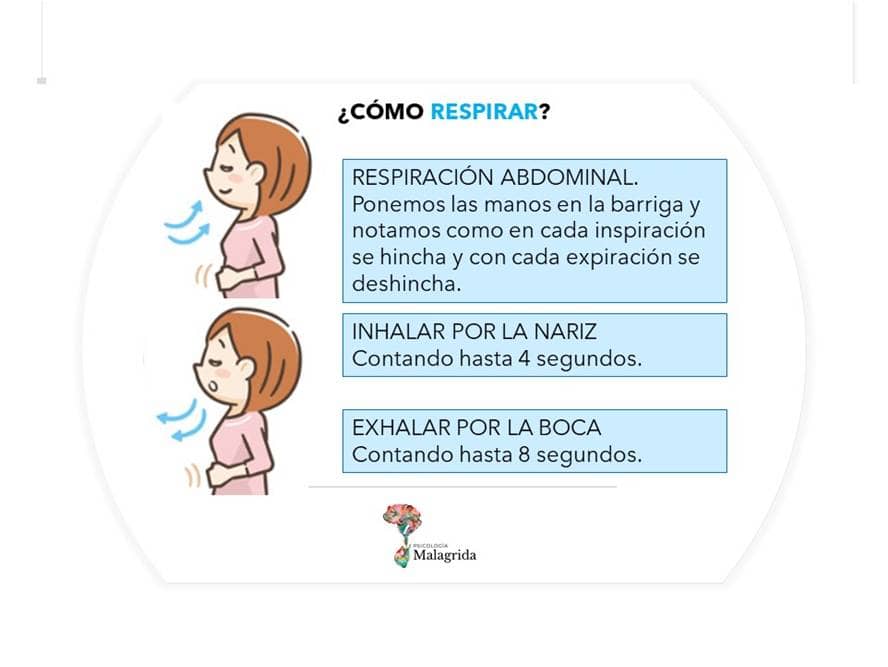
Abdominal or diaphragmatic breathing is the breathing we carry out naturally when we are babies and we need to recover it, as it provides many more benefits overall, as we saw in the previous post.
When to use abdominal breathing?
ALWAYS.
We have to train it so that it becomes our habitual breathing pattern, even when we exercise!
At first, it may be difficult to do it while walking or running, so you can start practicing it lying down on the bed, for example, then sitting, standing, walking, and finally running.
Place your hands on your belly and observe how your breathing is, what parts of your body move when you inhale and exhale. You might notice how your belly rises (that would be great because you already have the job done), or you might notice how your chest rises.
On the next breath, bring your attention to the inhalation and imagine all the air that enters through the nose going to your belly and feel it swell, and observe as you exhale through the mouth, your hands descend along your belly. Repeat this.
When you feel that you start breathing without much effort, it is time to count.
We inhale counting 1…2…3…4…And exhale counting 1…2…3…4…5…6…7…8…
At different times of the day, observe how your breathing feels and practice diaphragmatic breathing, even if it’s only for a few seconds. This will help your system integrate it as the normal breathing pattern!!
BREATHING TO SLEEP
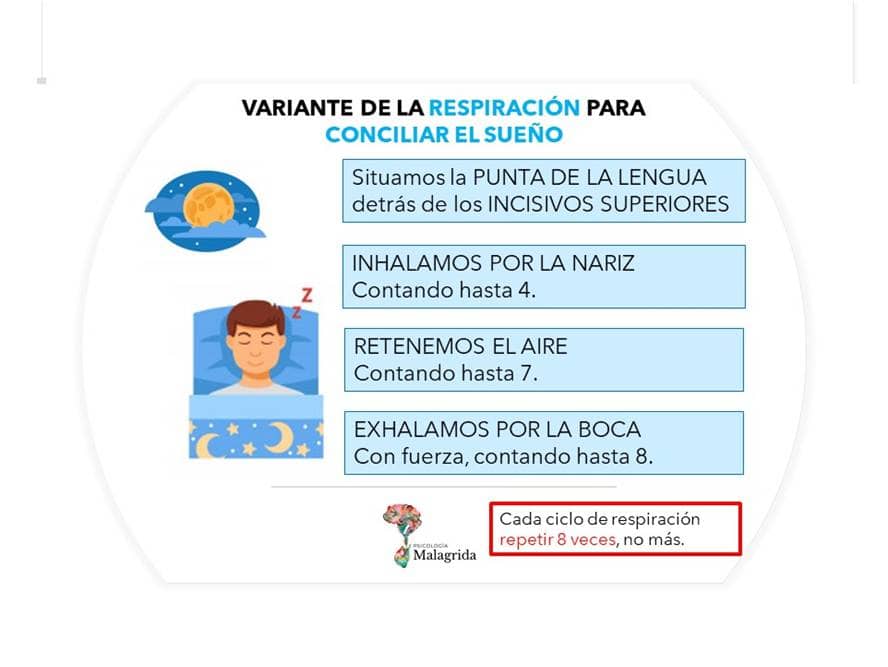
This type of breathing is called 4,7,8 and was initiated by Dr. Andrew Weill. This breathing is described by Harvard University as a “natural sedative for the nervous system” and can be very useful in helping us to fall asleep, or to calm ourselves when we feel discomfort.
Important:
- At first, we only do 4 cycles of inhalation-retention-exhalation; no more. After a week of training, we can increase the cycles to a maximum of 8 repetitions.
- If you get dizzy or can't keep counting to 7 during the hold, it's normal at first; it's like any training; at first it's difficult or it doesn't come out right away, and gradually it gets better.
This breathing is very similar to the previous one, but it has 2 variants. On the one hand, the Positioning of the tongue And on the other hand, the air retention between inhalation and exhalation.
- We place the tongue behind the upper incisors. We will keep it in place throughout the breathing cycle.
- We consciously relax the jaw and the rest of the body.
- We exhale all the air from inside our bodies.
- We take in air through our nose by counting to 4.
- We hold our breath inside by counting to 7. This point is the most important because by holding our breath there is an intra-abdominal pressure that stimulates the vagus nerve, sending signals to the brain to reduce its alert state and therefore its fight or flight response. This is important at this point. relax the body consciously, Especially the shoulders that tend to rise.
- We exhale air through our mouths by counting to 8. When we exhale, we do so forcefully, with the same force we would use to take a breath—no more.
This breathing technique can help you before an exam, before a meeting, in any situation that causes stress, before going to bed, or simply to help maintain a state of calm. You can repeat it 3 times a day.